News & Updates
Customs Errors Causing Delays at UK Borders
Customs errors causing delays can stop goods at the border. Learn how to prevent mistakes, keep UK and Ireland trade moving and avoid costly long holds.
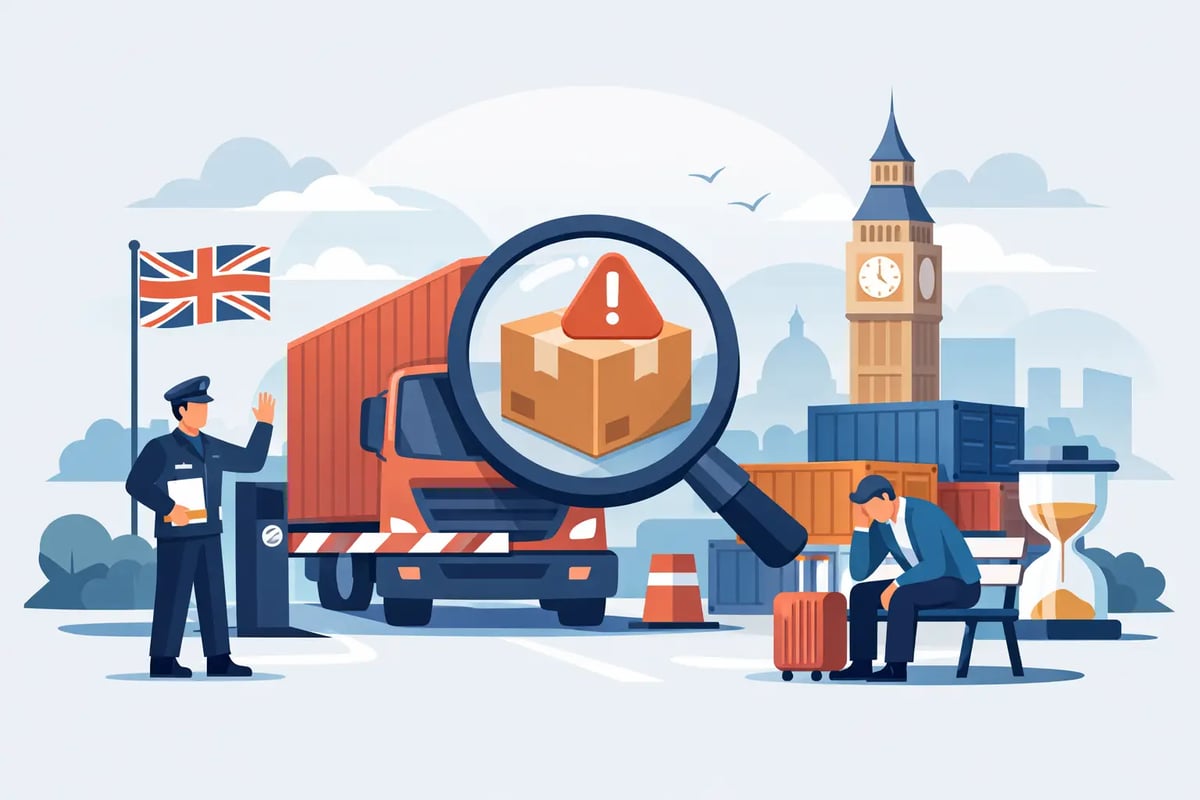
A truck can arrive at a port with the right goods, the right driver and a confirmed sailing, then still miss its movement because one declaration field does not match the commercial paperwork. Customs errors causing delays are rarely dramatic in isolation. More often, they are small operational gaps that trigger a query, a rejection, an inspection or a border hold at exactly the point when there is least time to correct them.
For UK and Ireland traders, the cost is not limited to a delayed consignment. It can mean missed delivery slots, storage and demurrage charges, disrupted production, unhappy customers and staff spending hours tracing data across invoices, packing lists and transport systems. The practical answer is not simply to submit declarations faster. It is to build a process that gets the information right before the goods start moving.
Why customs errors cause delays
Border systems assess whether a declaration is complete, consistent and supported by the information held elsewhere in the movement. A declaration can be technically submitted but still create a problem if its commodity code, customs procedure, value, origin or party details do not align with the commercial and transport documents.
The point at which an error becomes costly depends on the flow. For an import, it may prevent clearance or create a query after arrival. For an export, it can affect permission to proceed or cause issues when the goods are presented at the port. On accompanied movements through Great Britain and Ireland, a missing or inaccurate reference can also stop the vehicle at check-in.
Not every discrepancy leads to a physical examination. However, businesses should not treat that as a reason to accept poor data quality. A pattern of inaccurate declarations increases compliance risk and makes day-to-day operations harder to control.
The customs errors causing delays most often
1. Using the wrong commodity code
Commodity classification drives duty, import controls, licensing requirements and statistical reporting. Selecting a code based on a short product description, a previous supplier entry or an assumption that similar goods are classified alike is a common source of error.
The right code depends on what the item is, what it is made from, how it works and, in some cases, how it is packaged or presented. A code that looks close may carry different duty treatment or require a certificate, licence or additional declaration data. When classification is uncertain, resolve it before the goods are dispatched rather than relying on a correction after arrival.
2. Customs errors due to incorrect customs value or missing cost elements
The customs value is not always the amount shown as the unit price on an invoice. Depending on the transaction, freight, insurance, assists, commissions, royalties or other costs may need consideration. Currency conversion and valuation method also matter.
Undervaluation can attract obvious scrutiny, but over-simplified valuation creates operational issues too. Finance teams, purchasing teams and customs teams need a shared view of the information required for each shipment type, particularly where related companies, free-issue goods, returns or stock transfers are involved.
3. Claiming preference without adequate origin evidence
A zero-duty preference claim can be valuable, but it must be supported by the relevant origin statement or evidence and the goods must meet the applicable rules of origin. Country of dispatch, supplier location and origin are not interchangeable.
This is especially important in UK-EU trade. Goods moving from an EU member state are not automatically EU originating, just as goods sent from Great Britain are not automatically UK originating. If the evidence is unavailable or the origin rule has not been checked, paying the applicable duty may be safer than making an unsupported claim. The commercial trade-off should be decided deliberately, not by a last-minute tick box.
4. Mismatched documents and reference numbers
A declaration should tell the same story as the invoice, packing list, purchase order and transport document. Differences in quantities, weights, consignor details, package counts or goods descriptions can lead to questions that take time to untangle.
Reference numbers are equally important. Where a goods movement reference, movement reference number, safety and security declaration or transit reference is required, one incorrect character can prevent the next stage of the journey. Build a clear handover between the declarant, haulier and site or port team so everyone receives the correct references before departure.
5. Choosing the wrong procedure or authorisation details
The procedure code determines how goods are being entered and what customs treatment applies. Errors often arise where businesses use a code from an earlier shipment without checking whether the current transaction is actually the same.
This can affect returned goods, temporary admission, inward processing, customs warehousing, repairs, samples and goods moving under transit. Some procedures require an authorisation, a guarantee, specific supporting information or a follow-on action within a set timescale. The declaration must reflect the process the business can evidence and manage after clearance.
6. Missing licences, certificates or control data
Some goods need more than a standard customs declaration. Depending on the product and route, this may involve health certification, sanitary and phytosanitary controls, excise information, security data, import licences or a pre-notification.
These requirements can change according to commodity, origin, destination and the intended use of the goods. A generic goods description such as parts, food products or textiles is not enough for a reliable controls check. Good product data, maintained centrally, gives the customs team a practical basis for identifying what is needed.
7. Leaving declarations until the vehicle is ready to leave
Last-minute declaration processing creates avoidable risk. When a driver is waiting, a sailing is closing and several teams are chasing the same information, there is little room to investigate a classification query or obtain a missing origin statement.
There will always be urgent consignments, and some transport models demand quick turnarounds. Even then, the core data should be prepared in advance. A pre-shipment check is faster than resolving a rejection at the port, particularly outside normal office hours.
Build a process that catches customs errors earlier
The strongest customs process begins with ownership. Decide who is responsible for product classification, origin evidence, commercial values, transport references and final declaration approval. In smaller businesses, one person may cover several roles, but the responsibilities should still be documented.
A practical pre-departure check should confirm the commodity code, value, origin treatment, procedure, documents, licences and movement references. It should also confirm that the quantities and package details match the physical consignment. This is not unnecessary administration. It is the point at which a business can correct a problem without a vehicle queue, a terminal deadline or a customer waiting for stock.
Technology can reduce manual rekeying and help standardise repeat flows, but it cannot make unreliable source data accurate. The best results come from combining easy-to-use declaration software with clear master data and trained people who understand when an unusual shipment needs extra review.
For regular movements, create a controlled data set for each product or product family. Record the agreed commodity code, product description, country of origin, usual valuation approach, duty treatment and any documentary requirements. Review it whenever a supplier, material, route or commercial arrangement changes. A code copied from an old invoice can remain wrong for years if nobody is responsible for challenging it.
When to use in-house, agency or hybrid support
Processing declarations in-house gives a business direct control, visibility and the ability to act quickly. It works particularly well where movements are regular, product data is stable and staff have been trained on the relevant workflows.
Outsourcing may be the better option for low-volume traders, occasional complex movements or teams without customs capacity. The limitation is that an agent can only work with the data provided. Sending incomplete documents to an agency shortly before departure simply moves the pressure elsewhere.
A hybrid model is often the most practical route. Teams can process routine import or export declarations in-house while using specialist support for new procedures, classifications, origin reviews, transit movements or periods of peak activity. Custran supports this approach through customs software, training, advisory services and agency processing, allowing businesses to choose the level of control that suits their operation.
Make the next shipment easier, not just faster
When a declaration is rejected or a consignment is held due to customs errors, record the cause and correct the underlying process. Was the invoice unclear? Was a reference not shared with the haulier? Did a supplier provide an unsupported origin statement? A short review after each issue prevents the same error becoming a recurring cost.
The most reliable border operation is built before the lorry reaches the port. Give customs data the same attention as stock, transport planning and customer delivery commitments, and delays become far more predictable, preventable and manageable.