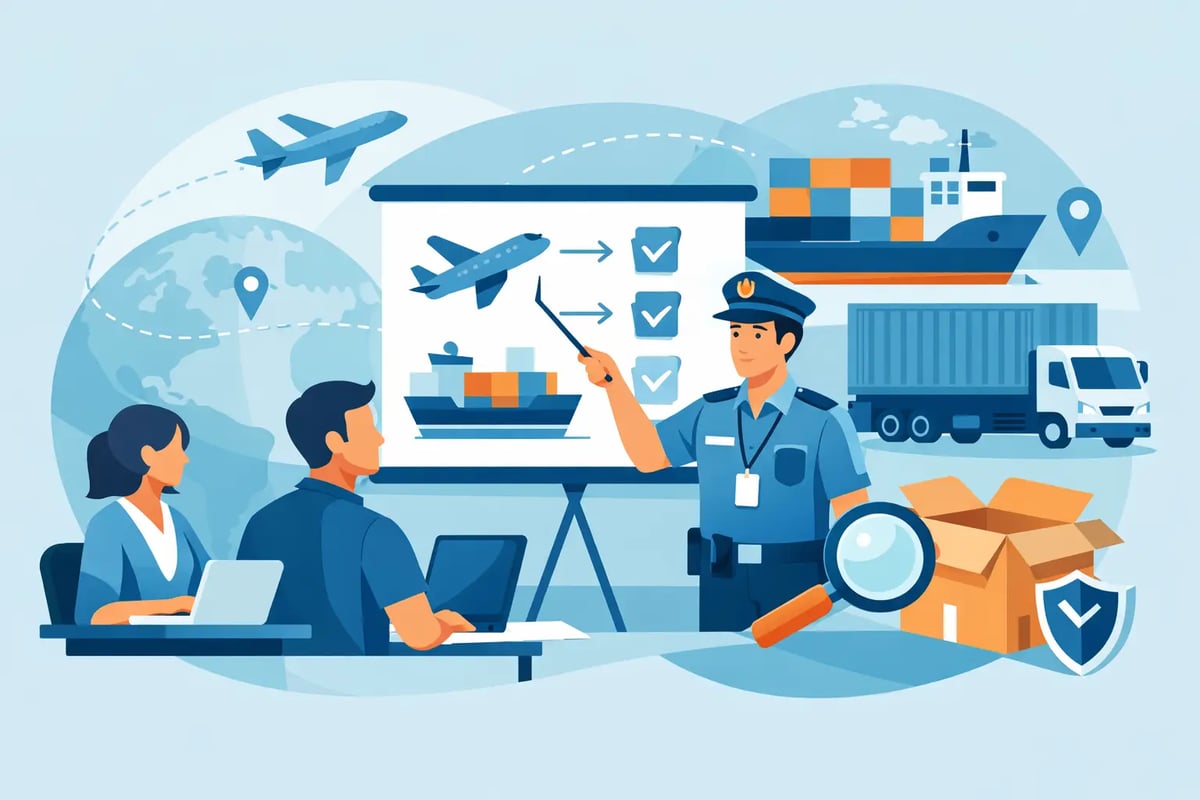
One missed data field can stop a consignment, trigger queries from a broker or carrier, and leave operations teams chasing paperwork instead of moving goods. That is why customs training for staff is not a box-ticking exercise. For UK and Ireland traders, it is a practical control that protects service levels, cash flow and compliance.
The challenge is that customs work rarely sits with one person. A customs administrator may submit declarations, but the information often comes from sales, purchasing, warehouse teams, transport planners and finance. If those teams do not understand what customs needs, errors start upstream. Incorrect commodity codes, missing origin data, poor invoice descriptions or incomplete transport references all create avoidable friction later.
For most businesses, the answer is not to turn every employee into a customs specialist. It is to train the right people to the right level, based on their role in the process. Good training should make customs simpler, not heavier.
Why customs training for staff matters in practice
When businesses talk about customs capability, they often focus on software or agency support first. Both matter. But neither fixes a team that does not know what information is needed, when it is needed, or why accuracy matters.
Training reduces repeat mistakes and improves handovers between departments. It also shortens onboarding time when new employees join a logistics or operations team. If you rely on one experienced member of staff who “just knows how it works”, you have a risk. Annual leave, staff turnover or a sudden increase in declaration volumes can expose that weakness very quickly.
There is also a wider business case. Customs errors do not only create border delays. They can lead to rework charges, postponed deliveries, unhappy customers, and extra pressure on already stretched transport and warehouse teams. In some cases, repeated inaccuracies can raise compliance concerns that are far more serious than an isolated delay.
That said, the level of training required depends on your model. A business completing declarations in-house needs deeper operational knowledge than a business outsourcing all entries to an agent. Even then, outsourced models still depend on internal teams supplying complete and correct data. Training remains necessary. It just looks different.
What staff actually need to know
The most effective customs training starts with process reality, not theory. Teams need to understand the specific movements they handle, the systems they use, and the decisions they are expected to make.
For import and export staff, the fundamentals usually include commodity codes, customs procedure codes, customs valuation, origin, Incoterms, document requirements and the difference between commercial and transport data. They should also understand how declaration timing affects goods movement, and where border systems such as CDS,GVMS,PBN or ROS fit into the workflow.
For transport and operations teams, the focus may be narrower but no less important. They need clarity on references, routing, pre-lodgement requirements, safety and security obligations, and what happens if a declaration is rejected or held. A planner does not need the same depth as a declarant, but they do need enough knowledge to spot a missing MRN, an incomplete movement, or a mismatch between booking data and customs status.
Finance and purchasing teams also play a part. Customs value, invoice structure, duty exposure and recordkeeping are not only customs issues. They affect landed cost, VAT treatment and audit readiness. Where these teams understand the customs impact of their data, the business usually sees fewer corrections and fewer surprises.
The difference between awareness training and operational training
Many companies make the mistake of buying one general customs session and assuming the issue is solved. In reality, there are two distinct types of training.
Awareness training gives non-specialist staff enough context to support the customs process properly. It is useful for sales, customer service, warehouse teams, drivers, account managers and senior managers who need to understand the basics without completing declarations themselves.
Operational training is more detailed. It is for the people creating, reviewing or managing declarations and border movements day to day. This training should be tied closely to the actual systems, data fields and movement types used by the business. It needs to cover what to do, what can go wrong, and how to correct issues quickly.
The right balance depends on your operation. A small importer may need two or three people trained to an operational level. A larger logistics business may need broad awareness across departments, plus deeper training for a core customs team.
How to build a training plan that fits your operation
Start with your process map. Look at where customs data enters the business, who touches it, and where delays or errors usually occur. That will tell you who needs training first.
If invoice descriptions are weak, the issue may begin in sales or customer service. If entries are being amended regularly, the problem may sit with customs administration. If lorries are arriving at ports without the right references, the training gap may be in transport planning or driver communication. Training works best when it is linked to actual failure points rather than assumed knowledge gaps.
Next, separate essential knowledge from specialist knowledge. Staff do not need long sessions on topics that never affect their work. A warehouse team handling sealed loads has different needs from a customs clerk completing import and export declarations every day. Keep the content role-based and practical.
Then decide how training will be reinforced. One-off sessions are useful for introducing concepts, but customs competence is built through repetition and live application. Short refresher sessions, process notes, checklists and supervised early declarations often make a bigger difference than a single classroom-style course.
This is also where technology matters. If your business wants to process your customs declarations in-house, training should sit alongside easy to use software and access to support when questions arise. Staff confidence grows much faster when they can apply what they have learned in a system designed for real operational use.
Common mistakes that training should prevent
The most valuable training is not abstract. It prevents the errors that slow goods down.
A frequent problem is treating customs as the final step rather than a data process that starts much earlier. If product descriptions are vague, origin is unclear, or invoices do not reflect the actual transaction properly, the declarant is left to fix gaps at the last minute. That is where mistakes happen.
Another issue is over-reliance on one experienced employee. This may work while volumes are steady and nothing changes. It becomes fragile when regulation shifts, system updates are introduced, or that person is unavailable. Cross-training a wider group gives the business resilience.
There is also a tendency to train only on legislation and not on workflow. Staff need both. Knowing the rule is useful, but they also need to know which document to check, which system field to complete, who owns the missing data, and what to do when a movement is urgent. Practical customs capability sits at that intersection.
In-house, outsourced or hybrid – training still matters
Businesses often ask whether training is still worth it if they use a customs agent. Usually, yes.
If you outsource all declarations, your internal teams still need enough understanding to brief the agent properly, review outputs, and provide complete information on time. Without that knowledge, delays simply move from your team to your provider.
If you process declarations in-house, training is obviously central. But it should be supported by clear escalation routes and expert backup, especially for unusual movements, new products or changing border requirements.
For many businesses, the best fit is a hybrid model. Routine declarations are handled internally, while more complex cases, peaks in volume or technical questions are supported by specialists. That model often gives the strongest mix of control, continuity and compliance, particularly for SMEs building customs capability over time.
What good customs training looks like
Good training is specific, current and operationally useful. It reflects UK and Ireland border reality rather than generic international trade theory. It uses examples that match the business, whether that means groupage movements, direct loads, parcel shipments, postponed VAT accounting, or movements through particular ports and ferry routes.
It should also be updated as systems and requirements change. Customs is not static. CDS developments, safety and security changes, NCTS5 processes and route-specific requirements can all affect what staff need to do. Training that was accurate a year ago may now be incomplete.
Most importantly, it should leave people more confident in their day-to-day role. Not overloaded. Not dependent on memorising regulation. Just clearer on what matters, what they need to input, and where to get help when something falls outside the usual process.
That is the practical value of customs training for staff. It turns customs from a recurring fire drill into a controlled business process. And when your team understands the job well enough to keep goods moving without guesswork, everything else becomes easier to manage.