News & Updates
UK To Keep The Land Bridge Open
enjoyed the benefits of the four pillars of the European Union since they were
UK to keep
the land bridge open
The UK has
enjoyed the benefits of the four pillars of the European Union since they were
enshrined in the Maastricht Treaty back in 1992 and again in the Lisbon Treaty
in 2007. The free movement of goods, capital, labour and services is about to
change radically for the UK. Post-Brexit the UK will be out of the European
single market and the EU customs union. As much as Downing Street promotes the
advantages of this new global opportunity, British businessesface unanswered
questions and unclear post-Brexit trading scenarios.
The UK land
bridge has acted as a corridor for roll-on-roll-off (RoRo) trade between
Ireland and the UK for decades. Dublin Port and Rosslare Europort are the lifeline
for Irish trade with the UK and the European mainland. Perishable goods and
Agri food products are transported through the land bridge on a daily basis.
The UK in fact is reliant on the Irish economy for fresh food products. In 2017
38% (€5.2 billion) of our total Agri-foods exports went to the UK.
The supply
chains the underpin the food sector in the UK and Ireland predominantly use a
just-in-time solution to keep costs down by reducing warehousing prices and
reducing inventory. This system has been predicated by relatively low fuel
costs and the lowering of barriers to trade. Now that the UK will be out of the
single market and EU customs union, those barriers have gone up again.
The British
Government have stated again and again that east west trade between Britain and
Ireland will remain open and checks will not be routine. Apart from proclaiming
that there will be a border down the Irish Sea, the plan is quite vague.
A recent article in the Irish Independent has described
the proposal.
Irish trucks will continue
to move even if there is a crash-out, no-deal Brexit, the official, who spoke
on condition he not be identified, said.
The UK has already decided
that in the absence of agreed rules, the free flow of goods would take higher
priority to collecting tariffs.
“Customs declarations
and the associated paperwork can be done afterwards,” he said. “If
you arrive at Holyhead and you don’t have all the paperwork done and dusted,
you won’t be turned back or impounded.
“You will get waved
through with a kind of: ‘Please can you sort out customs processes within four
weeks?’ .
In a way the British government has no
option but to allow trade to flow as per usual. The British economy depends on
this lifeline. Also, there are few alternatives for the transportation of
goods. There are only a small number of routes from Dublin and Rosslare to
mainland Europe, which by-pass mainland Britain. Short-sea shipping companies
cannot add additional vessels to routes or open up new routes, as the Brexit
goalposts keep shifting. One of these shipping companies CLdN has added a new
route from Dublin to Belgium to cater for larger companies who are changing
their supply chains to adapt to a post-Brexit trading environment.
Dublin Port Company
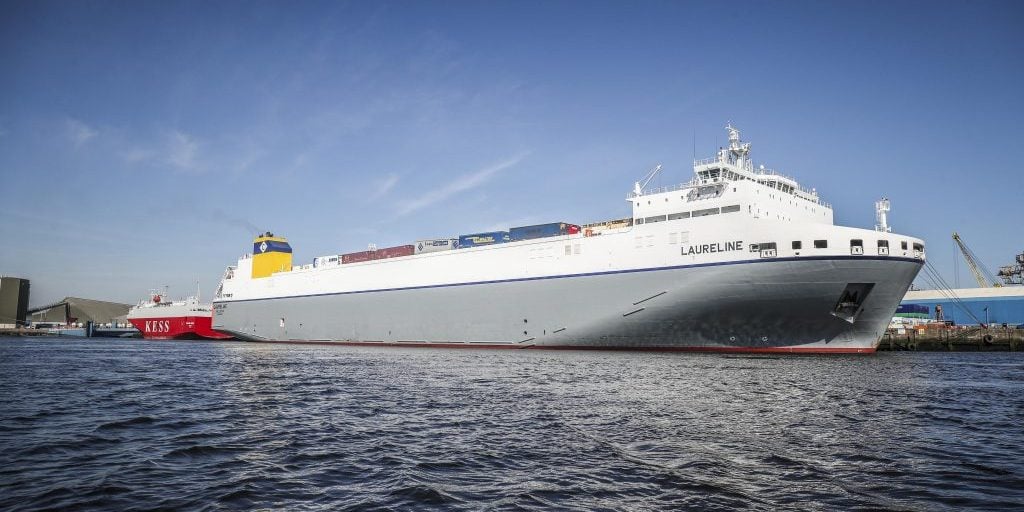
NEW BREXIT BUSTER SISTER SHIP “MV LAURELINE” EXPANDS DUBLIN PORT’S
DIRECT ROUTE CARGO SAILINGS TO EUROPE
Departing Dublin Port on the original “Brexit Day” of March 29th,
the ship offers additional capacity to customers needing direct shipping routes
between Dublin and Continental Europe and is the latest addition to the CLdN
fleet. Built in Ulsan, South Korea, the MV Laureline is the third new ship
generation in the CLdN fleet to enter service in Dublin Port, following the MV
Mazarine in 2010 and the MV Celine in 2018, both of which were christened in
Dublin .
Choice is always welcome, and these new
routes can support some of the market. The vast majority of the Irish RoRo
traffic will continue to use the traditional routes with uncertain customs
regimes and checks in operation . Planning with your haulage company and
customs agent to ensure customs declarations are processed and contingency
routes are organised will become increasingly important.
Very little has been mentioned to date
about truck drivers, post-Brexit. Many drivers operating in the UK and Ireland
are not citizens of Ireland or the UK. Post-Brexit what will the status of a
Polish or Russian driver be when entering or leaving the UK or the EU. What will
the requirements be now that the free movement of people is no longer
guaranteed? Partnering with UK based haualge companies and exploring the
possibilities of unaccompanied trailers to reduce the number of drivers
required to complete a shipment, may now be a real option.