News & Updates
8 Best Ways to Reduce Border Delays for Hauliers
Learn the best ways to reduce border delays across UK and Ireland routes, from accurate declarations to driver checks, pre-lodgement and expert support.
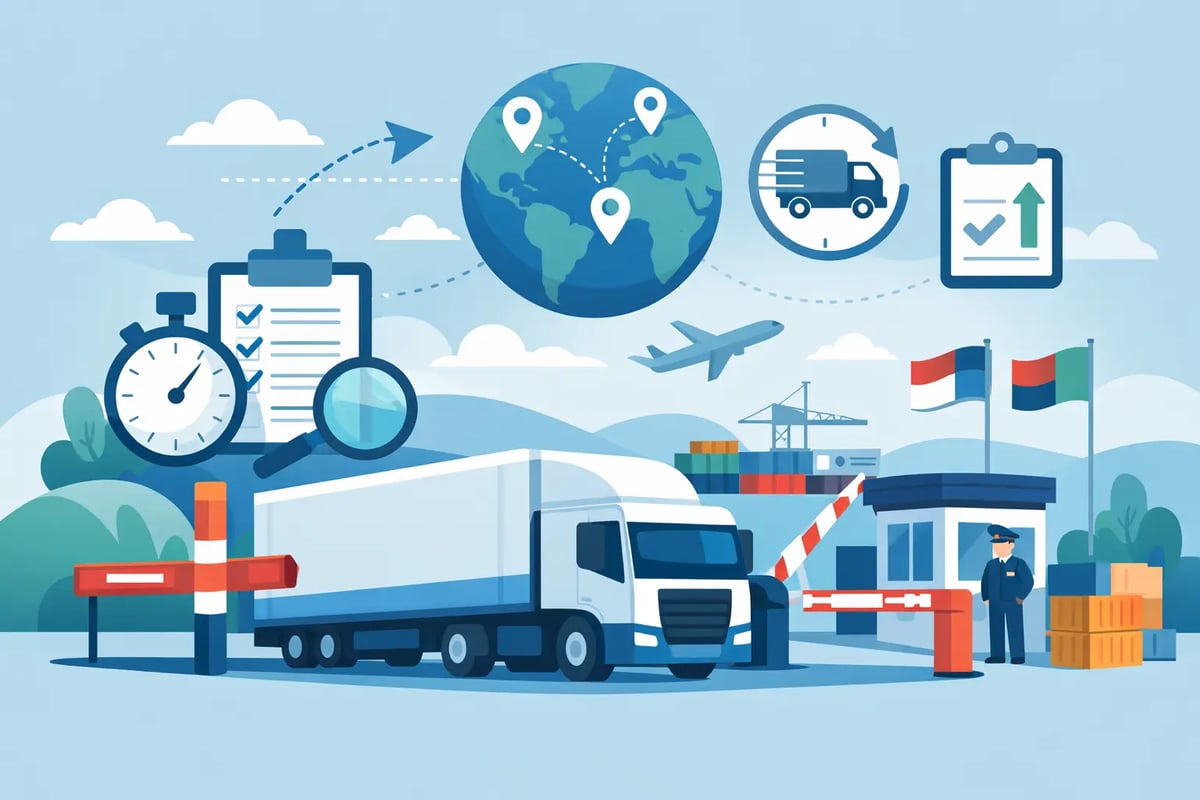
A truck arriving at a port without the right customs references can lose its sailing slot within minutes. The knock-on effects are rarely limited to one vehicle: missed delivery windows, waiting-time costs, frustrated customers and pressure on already stretched operations teams can follow. The best ways to reduce border delays are therefore not about rushing paperwork at the last minute. They depend on building a controlled process that gets customs data, movement references and driver instructions right before the goods reach the border.
For businesses trading between Great Britain, Northern Ireland, the Republic of Ireland and the wider EU, the requirements vary by route, goods and customs procedure. The practical objective remains the same: give every party in the movement the information they need, in the format they need it, at the point they need it.
Best ways to reduce border delays before departure
1. Treat declaration data as an operational input
A customs declaration is not simply a finance or compliance task completed after a sale. It is an operational document that determines whether goods can move. Incorrect commodity codes, customs values, origin details, procedure codes, weights or consignee information can lead to queries, amendments, inspections or rejected declarations.
Start with accurate master data. Product descriptions should clearly state what the goods are, what they are made of and their intended use. Descriptions such as “parts”, “samples” or “equipment” create unnecessary uncertainty. Your team also needs a clear process for checking commercial invoices, packing lists and transport details against the declaration before submission.
The trade-off is time upfront versus delay later. A short pre-departure validation can feel difficult when a collection is urgent, but it is normally far quicker than correcting a declaration while a driver waits at a terminal. For frequent product lines, maintain approved commodity codes and standard data records, then review them when goods, suppliers or regulations change.
2. Submit declarations and safety filings early enough
Pre-lodgement is one of the most effective controls for roll-on roll-off traffic. Where a route requires declarations or references to be linked to the vehicle before check-in, leaving submission until the driver is approaching the port creates avoidable risk. Government systems, community systems and ferry cut-off times do not allow much room for recovery when a reference is missing.
Build your operating timetable backwards from the sailing. Agree a document cut-off with customers, suppliers, hauliers and customs staff that leaves time to prepare declarations, resolve exceptions and generate the required movement references. The cut-off should be realistic for the route, not an aspirational deadline that is routinely ignored.
This applies to safety and security information as well as customs declarations. Depending on the movement, ENS, S&S GB or other safety and security filings may be required. A complete import or export declaration does not automatically mean every border obligation has been met.
3. Match the movement reference to the vehicle and route
A valid declaration reference is only useful if it is correctly associated with the movement. For many GB-EU and GB-Ireland routes, operators may need to create and share a Goods Movement Reference through GVMS. Movements involving Ireland can also require PBN steps, while transit operations may involve NCTS5 references. Each process has its own timing and data requirements.
The common failure is assuming that a reference sent by email is enough. Someone must confirm that the reference has been entered into the relevant system, linked to the correct registration and trailer where applicable, and accepted before the vehicle checks in. Changes to the tractor unit, trailer, ferry booking or route can invalidate the original plan.
Use a simple movement checklist that records the vehicle registration, trailer number, booking reference, declaration MRNs, GMR or PBN status, driver details and destination. This gives the transport planner a single source of truth rather than forcing them to search through emails and messages when a check-in problem occurs.
4. Give drivers clear, route-specific instructions
Drivers should not be expected to interpret customs requirements at a port gate. They need concise instructions that state which references they need, whether they must carry documents, what to do if the vehicle is selected for a check, and who to call outside normal office hours.
Instructions must be route-specific. A driver travelling from Great Britain to Northern Ireland may face a different process from one travelling from Great Britain to the Republic of Ireland or mainland Europe. The same is true for accompanied and unaccompanied freight. A generic customs briefing is useful for awareness but will not prevent operational mistakes on a live movement.
Make the instructions easy to use under pressure. Put key references in one message or document, avoid unclear abbreviations and ask the driver to confirm receipt before departure. If a reference is supplied late, the planner should verify that the driver has received the updated version rather than relying on a message sent to a shared inbox.
Reduce exceptions with better document control
5. Keep commercial documents consistent
Border teams and customs authorities compare the declaration with commercial evidence. Differences in quantities, values, currency, consignee details, Incoterms or goods descriptions can trigger a query, particularly when the discrepancy affects duty, VAT or eligibility for a relief.
Create one controlled handover point for the invoice, packing list, transport details and any licences, certificates or preference statements. This is particularly valuable where sales, warehousing, purchasing, freight forwarding and customs activities are handled by different people or businesses.
Some goods require additional controls, including sanitary and phytosanitary documentation, health certification, licences or product-specific approvals. These movements need earlier planning because the relevant evidence may need to be arranged before the declaration can be completed. Trying to treat controlled goods like ordinary general cargo is a reliable way to create a hold at the border.
6. Make customs ownership explicit
Delays often arise because several parties assume someone else is responsible. The exporter may expect the haulier to arrange export customs. The haulier may expect the freight forwarder to create the GMR. The importer may believe a supplier has managed the safety filing. By the time the gap becomes visible, the vehicle may already be queued.
For each route, document who is responsible for declaration preparation, data approval, safety and security filings, transit formalities, GMR or PBN creation, document retention and communication with the driver. Name a primary contact and a back-up contact. This is especially important outside office hours and during peak sailing periods.
A hybrid model can work well for growing businesses. Internal teams can process routine declarations in-house, retaining visibility and control, while a customs specialist provides support for unfamiliar commodity codes, complex procedures, surges in volume or staff absence. The right approach depends on internal knowledge, transaction volume and the commercial cost of a missed crossing.
7. Train the people who create and release movements
Customs knowledge cannot sit with one experienced employee. If only one person understands how to identify a missing MRN, correct a declaration or respond to a routing change, the process is exposed whenever they are unavailable.
Training should focus on the decisions your team makes every day: which documents to request, when a transit movement is needed, how to check declaration status, what information a driver needs and when to escalate a problem. It should also be refreshed as UK and Irish border processes change.
Technology makes training more effective when it presents the right workflow to the user. Easy-to-use customs software can guide less experienced staff through declaration fields and connect directly with systems such as HMRC CDS, CSPs and ROS. However, software cannot repair poor source data or replace a clear understanding of who owns the movement. Process and training still come first.
Build a response plan for the movements that go wrong
8. Monitor status and act before the truck reaches check-in
Even well-prepared movements can be selected for documentary or physical checks, and system availability can occasionally affect processing. The difference between a manageable exception and a costly delay is usually how quickly it is identified and who can act on it.
Monitor declaration and movement status before the vehicle leaves site, before it reaches the port and before the ferry cut-off. Give planners authority to pause a departure if critical references are not in place. Sending a vehicle in the hope that an outstanding filing will be completed on the road is not a contingency plan.
Keep escalation contacts for your customs provider, ferry operator, forwarding partner and customer available to the operations team. Record what went wrong after any border issue: the missing data, the point at which it should have been identified and the control that will prevent a repeat. Over time, this turns recurring disruption into a more reliable operating process.
Border delays cannot be eliminated completely, particularly where inspections or external system issues are involved. They can, however, be made far less frequent and far easier to manage. When accurate data, timely filings, clear ownership and trained people sit behind every movement, customs becomes a planned part of transport operations rather than a last-minute obstacle. Custran helps businesses put that control in place through practical customs software, training, advice and agency support when extra hands are needed.