News & Updates
7 Key Customs Digitisation Trends in 2026
Customs digitisation trends 2026: cleaner trade data, direct connectivity, earlier safety filings, exception handling and audit readiness for UK and Ireland.
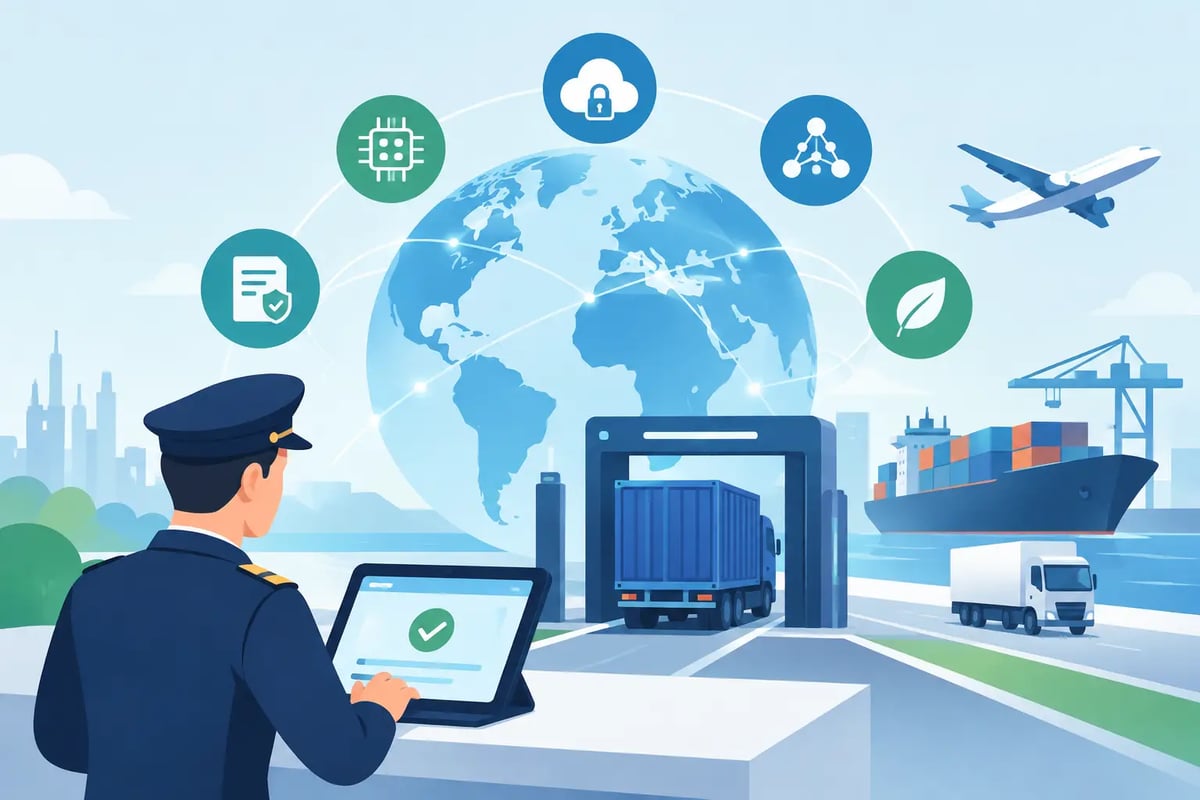
A delayed declaration, a missing movement reference or a data mismatch can still stop a consignment long before a lorry reaches the border. Customs digitisation trends 2026 are therefore less about adopting technology for its own sake and more about giving trade teams clearer control of data, deadlines and exceptions.
For UK and Ireland businesses, the direction of travel is clear. Border processes are becoming more data-led, more connected and less tolerant of information being corrected at the last minute. The businesses best placed to keep goods moving will not necessarily have the largest customs departments. They will have practical processes, trained people and systems that fit the way their operation actually works.
What customs digitisation means in 2026
Digitisation does not mean that customs expertise disappears. It means routine information can be captured once, checked earlier and used consistently across declarations, safety and security filings, movement systems and commercial records.
That matters on the UK and Ireland trade corridor, where a single movement may require several linked actions. Depending on the route and goods, teams may need to manage import or export declarations, ENS, NCTS5, S&S GB, GVMS, PBN and arrival formalities. A digital process should make these requirements easier to manage, not simply move the same manual work from paper to a screen.
The strongest approach is usually a blend of software and human judgement. Automation is highly effective when data is consistent and the movement is familiar. Expert review remains essential for commodity classification, valuation, origin, special procedures and unusual movements. The aim is not zero-touch customs at all costs. It is faster, more accurate processing with a clear route for handling exceptions.
7 customs digitisation trends for 2026
1. Declaration data will be treated as an operational asset
Customs data has often been held in separate spreadsheets, broker emails and transport records. In 2026, more businesses will treat it as operational data that should be available, structured and reusable. Product descriptions, commodity codes, country of origin, customs value and authorisation details need to be accurate before the declaration is created.
This shift reduces repeated keying and gives teams better visibility of recurring errors. It can also support purchasing, finance and customer service teams, provided ownership is clear. Good data is not just a customs administrator's responsibility. It begins with the people who create product, supplier and sales information.
2. Direct connectivity will matter more than disconnected portals
Using separate portals for each border requirement creates avoidable pressure when volumes rise. Businesses will increasingly favour customs platforms that connect directly with relevant government and community systems, while keeping declaration status and reference numbers in one operational view.
For UK and Ireland operators, connectivity to HMRC, CDS, CSPs and ROS is particularly valuable. So is the ability to support movement-related workflows without forcing staff to re-enter the same information repeatedly. Direct connectivity does not remove the need for checks, but it shortens the gap between submitting information and identifying a problem that needs attention.
3. Safety and security data will move earlier in the process
Safety and security obligations are pushing border data collection further upstream. Transport operators, freight forwarders and exporters need accurate consignment details before a vehicle is dispatched, not once it is already approaching a port.
This will place greater emphasis on communication between the commercial team, warehouse, haulier and customs function. Where the haulier holds only partial information, the risk of late amendments and border disruption increases. The practical answer is to agree who supplies each data field, when it is supplied and who checks it before departure.
4. Exception management will become a bigger buying decision
A system that processes a straightforward declaration quickly is useful. A system that helps an operator resolve a rejected message, missing MRN or movement discrepancy is more valuable in day-to-day trade.
In 2026, businesses should look beyond headline automation claims and ask how the process works when something goes wrong. Can the user see the rejection reason clearly? Can they correct the data without starting again? Is there an audit trail? Can an expert step in when an unfamiliar procedure or border message needs interpretation? These are the details that protect business continuity during busy periods.
5. In-house capability will grow, supported by flexible expertise
Many SMEs are moving selected declaration activity in-house to improve visibility, control costs and avoid dependence on a single external provider. This does not mean every business should stop using an agency. It depends on declaration volumes, the complexity of goods, staff availability and the business's appetite for compliance responsibility.
A hybrid model is likely to become more common. Routine declarations can be completed by trained internal staff, while complex, seasonal or urgent work is supported by a customs agency or adviser. This gives businesses control without expecting a small operations team to become expert in every procedure overnight.
6. Training will become part of the technology rollout
Customs software is only as effective as the people using it. As processes become more digitised, businesses will need training that is tied to real workflows: creating a declaration, responding to a rejection, checking evidence of origin and managing movements at the border.
One-off introductory sessions have value, but they are rarely enough. Staff turnover, regulatory updates and infrequent procedures can quickly create knowledge gaps. Regular refresher training, clear desk procedures and access to operational support will be as important as the software interface itself.
7. Audit readiness will be built into everyday work
Customs compliance is increasingly judged by the quality of the records behind the declaration. A business needs to be able to show where key data came from, why a code or value was used, and who made a change.
Digital systems can make this easier by retaining records, references and user actions in a structured way. However, technology cannot prove the accuracy of poor source data. Businesses should establish a routine for reviewing commodity codes, supplier origin statements, valuation inputs and procedure use. A clean audit trail is most useful when the underlying decision-making is sound.
How to prepare your operation for the shift
Start with the points where customs information is created and changed. Map the journey from order or booking through to departure, arrival and post-clearance records. This often reveals that the customs team is receiving incomplete product data, late transport details or conflicting instructions from several sources.
Next, separate high-volume routine work from high-risk or unusual work. Routine movements are the best candidates for standard templates, saved data and internal processing. Complex cases may need a defined escalation route to a trained specialist or agency partner. This prevents staff from guessing under time pressure.
It is also worth reviewing whether your current process gives you a single, usable view of status. Your team should be able to identify submitted declarations, rejected messages, outstanding actions and movement references without chasing multiple inboxes. Custran supports this practical model by combining cloud customs software with training, advice and agency support where internal resources need extra cover.
Finally, test the process before a busy trading period. Run realistic scenarios such as an amended invoice, a changed haulier, an incorrect commodity code or a rejected declaration. The purpose is not to create more administration. It is to make sure staff know what to do before an exception affects a live consignment.
Keep digitisation grounded in the movement
The best customs technology in 2026 will be the technology that helps a warehouse release goods, a haulier cross the border and a trade team evidence compliance with less friction. Choose tools and support around your real movements, your people and the decisions they need to make. When the process is clear, customs becomes a manageable part of the operation rather than a last-minute obstacle.