News & Updates
Post Brexit Customs Compliance That Works
Post Brexit customs compliance means getting declarations, data and systems right. Learn what UK and Ireland traders need to keep goods moving.
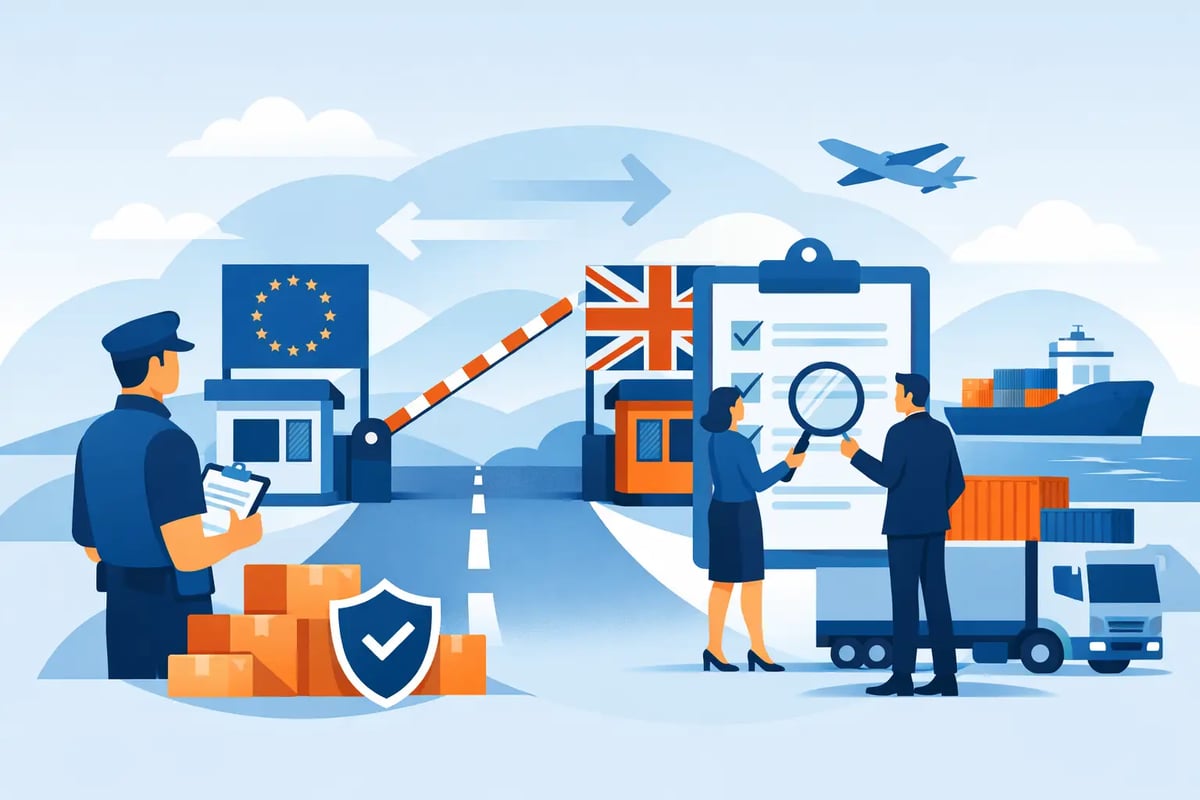
A late trailer at the port rarely starts at the port. More often, the problem began hours earlier with the wrong commodity code, a missing safety and security filing, or a team member unsure which system needed updating. That is what post Brexit customs compliance looks like in practice. It is not a policy discussion. It is an operational discipline that affects whether goods move on time, whether declarations are accepted first time, and whether your business avoids cost, delay and unnecessary customs risk.
For UK and Ireland traders, compliance has become part of day-to-day transport planning, customer service and cash flow management. If you import, export, operate groupage, run trailers across the Irish Sea, or manage loads for clients, customs is no longer a back-office task that can be dealt with later. It sits right in the middle of the movement.
What post Brexit customs compliance really involves
At its simplest, post Brexit customs compliance means making sure every cross-border movement meets the customs, transit and safety requirements that apply to that specific route and that specific consignment. The detail matters because the process is rarely identical from one movement to the next.
A standard import declaration into Great Britain is one thing. A groupage movement through Northern Ireland is another. Add in excise goods, SPS controls, temporary storage, GVMS, PBN,NCTS5 or ENS, and the operational picture changes again. Businesses often struggle not because customs is impossible, but because they try to apply one process to every movement.
That is where compliance often breaks down. Teams rely on memory instead of process, spreadsheets instead of connected systems, or one experienced staff member instead of a properly trained operation. It works until volumes increase, regulations change or that key person is on leave.
Why so many businesses still get caught out
Most customs errors are not dramatic. They are routine and repetitive. Incorrect values, incomplete data, poor master data management, mismatched references, and uncertainty over who is responsible for each filing are common across importers, exporters, haulage operators and intermediaries.
There is also a wider issue. Brexit did not simply add declarations. It changed the skill set needed inside trade businesses. Operations teams now need enough customs awareness to recognise what type of movement they are handling, what information is required, and what happens if data is wrong. Finance teams need visibility of duty and VAT treatment. Transport teams need confidence that border references are valid before a vehicle starts moving.
For SMEs, that creates a practical challenge. You may not have a large in-house customs department. You may have one customs administrator covering multiple tasks, or an operations team handling customs alongside bookings, customer updates and haulier coordination. In that environment, compliance needs to be easy to use, repeatable and supported.
The core building blocks of customs compliance after Brexit
Good post Brexit customs compliance depends on four things working together: accurate data, clear process, trained people and reliable system connectivity.
Accurate data comes first. If your product descriptions are vague, your commodity codes are inconsistent, or your origin data is not maintained properly, every declaration becomes harder than it needs to be. Poor data creates rework, and rework creates delay.
Clear process matters just as much. Staff need to know when a full declaration is required, when transit applies, when safety and security filings are needed, and what references must be in place before departure or arrival. This should not live in one person’s inbox. It should be part of how the business operates.
Trained people are the difference between a system being installed and a process actually working. Even easy-to-use customs software still depends on users understanding what they are submitting. Training does not need to turn every operator into a customs specialist, but it does need to give staff enough confidence to process declarations correctly and spot exceptions early.
Then there is connectivity. If your customs platform connects directly with HMRC, CDS, CSPs and ROS, teams can work with more confidence and fewer manual workarounds. That matters when goods are moving to tight schedules and when reference numbers need to be generated, validated and communicated quickly.
Where compliance decisions affect operations most
The biggest pressure points are usually imports, exports and transit, but the exact risk area depends on your role in the supply chain.
For importers, the common issue is incomplete commercial data arriving too late. Purchase invoices, transport details and classification data often sit in different places, making it difficult to build an accurate declaration in time. For exporters, proof of origin, valuation and destination-specific requirements tend to cause problems, particularly where customers assume the shipper will manage everything.
For hauliers and ferry-related operations, the pressure is often around movement readiness. Is the vehicle linked to the correct border references? Has the right pre-lodgement process been completed? Are all consignments on a grouped movement customs-cleared for departure? Small failures here can create visible disruption very quickly.
For freight forwarders and 3PLs, the challenge is scale. You may be processing for multiple clients, each with different products, Incoterms, data quality standards and service expectations. Compliance becomes harder when customer onboarding is weak or when customs information is gathered too late in the booking cycle.
In-house, outsourced or hybrid – which model works best?
There is no single right answer. Some businesses benefit from processing declarations in-house because they have volume, internal capability and a need for direct control. Others are better served by an agency model, especially if customs volumes are irregular, staff capacity is limited or movements are more complex than the business can comfortably manage.
A hybrid model often works best in practice. Routine declarations can be handled internally using software, while complex entries, peak periods or unusual movements are supported by customs specialists. That gives businesses control without leaving operational teams exposed when something falls outside the norm.
This is where many companies make better progress once they stop treating customs software and customs support as separate decisions. In reality, the strongest setup usually combines both. Easy-to-use systems help teams process declarations in-house, while expert backup, training and advice reduce risk when volumes grow or rules change.
Making post Brexit customs compliance easier to manage
The businesses coping best are usually not the ones with the biggest compliance teams. They are the ones that have made customs a defined operational process.
That starts with mapping your movement types. If you move standard imports, exports, groupage consignments and transit movements, document each workflow separately. Identify what data is needed, who provides it, which system is used, and what must happen before a lorry departs or arrives.
Next, clean up your core data. Commodity codes, product descriptions, values, customer references and origin information should be maintained properly rather than rebuilt every time. Reusable, accurate data saves time and reduces avoidable declaration errors.
After that, look at system fit. If your team is copying information between portals, emailing reference numbers around the business and relying on manual checks before departure, there is usually room to improve. Connected software reduces friction, but only if it matches the reality of your operation and can support the workflows you actually run.
Finally, invest in practical training. Not generic awareness training, but training tied to your routes, your movement types and your internal process. Staff do not need theory for theory’s sake. They need enough knowledge to do the job correctly and escalate exceptions early.
Compliance is not static
One reason customs feels difficult is that businesses expect to fix it once. In reality, compliance changes with your trade profile. New suppliers, new customer markets, changed Incoterms, different ports, revised systems or updated border rules can all alter what is required.
That means post Brexit customs compliance should be reviewed regularly, especially if your operation has grown quickly or adapted informally over time. A process that worked for ten declarations a week may fail at fifty. A workflow managed comfortably by one experienced employee may become fragile once holiday cover or night operations are involved.
The practical aim is not perfection. It is control. You want declarations processed accurately, staff clear on responsibilities, and enough support in place to keep goods moving when pressure increases.
For many UK and Ireland businesses, customs now sits alongside transport planning and customer service as a core trading function. Treat it that way, and it becomes manageable. Build the right mix of process, software, training and expert support around your operation, and customs stops being a recurring fire to fight. It becomes part of how you keep promises to customers and keep freight moving with confidence.